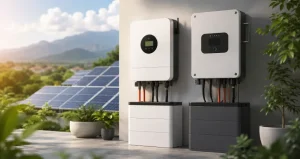
Choosing a hybrid solar system for a South African home is no longer simply about keeping the lights on when grid electricity is unavailable. A well-designed system can use rooftop solar during the day, store excess energy in a lithium battery and automatically use grid electricity when additional power is required. This flexibility makes hybrid solar particularly practical for households that want both backup power and lower dependence on purchased electricity.
The difficult part is deciding what size system actually suits your home. A cheaper 5kW package may be perfectly adequate for an efficient household, while a family running several high-demand appliances may quickly discover that an 8kW system provides better everyday usability. Battery capacity, panel capacity, inverter quality, installation standards and expandability matter just as much as the number printed on the inverter.
This guide compares the most useful types of hybrid solar kits for South African homes, explains realistic price ranges and looks at financing options. Rather than ranking systems only by price, the focus is on usable capacity, long-term ownership and how the equipment performs as a complete home energy system.
What Is a Hybrid Solar Kit?
A hybrid solar kit combines solar panels, a hybrid inverter and battery storage while retaining a connection to the electricity grid. During sunny periods, the panels can supply household loads and charge the battery. Stored electricity can then be used later in the evening or when grid supply is interrupted. If solar and battery power are insufficient, the inverter can draw additional electricity from the grid.
This is different from a basic grid-tied solar installation without batteries. It also differs from a completely off-grid system because the household can continue using the utility connection as another energy source. For many South African properties, that flexibility is one of the strongest reasons to choose hybrid rather than immediately attempting complete grid independence.
Best 5kW Hybrid Solar Kit for Smaller Homes
A 5kW hybrid inverter is a sensible starting point for many small and medium households. It can support essential circuits such as lighting, televisions, internet equipment, refrigeration and normal plug loads, provided high-power appliances are managed carefully.
A balanced package would typically combine a 5kW hybrid inverter with roughly 5kWh of lithium storage and an appropriately sized PV array. Current South African component pricing illustrates why complete installed packages can vary considerably. A Deye 5kW hybrid inverter has recently been listed at about R16,890 including VAT, while a Deye 5kVA inverter and 5.12kWh Hubble battery backup kit has been listed at about R53,495 before adding a complete rooftop PV installation.
For a properly installed 5kW hybrid solar system with panels and lithium storage, homeowners should generally budget around R70,000 to R110,000, depending on panel quantity, battery brand, protection equipment, roof complexity and installation work. This category offers particularly good value when the objective is to cover essential loads rather than every electrical appliance simultaneously.
Best 8kW Hybrid Solar Kit for Family Homes
For a larger household, an 8kW hybrid inverter is often the more comfortable choice. The extra inverter capacity makes it easier to operate multiple everyday appliances without constantly thinking about the total instantaneous load. A practical configuration may include an 8kW inverter, approximately 8 to 12kWh of lithium battery storage and a larger rooftop PV array.
Expect many professionally installed systems in this category to fall somewhere around R120,000 to R180,000 or more. The higher upfront cost should not automatically discourage buyers. If electricity consumption is high enough to justify the additional panels and storage, the larger system can provide considerably more useful solar energy over its lifetime.
Our preferred approach is to size the inverter around peak demand but size the panels and battery around actual energy consumption. Installing an oversized inverter with too little PV generation or battery capacity often produces an impressive specification sheet without delivering equally impressive practical value.
Best 10kW to 12kW Hybrid Kit for High-Consumption Homes
A 10kW or 12kW system is more appropriate for large properties, households with substantial daytime consumption or homes planning to electrify more of their energy use. These installations may be paired with 10 to 20kWh or more of battery capacity and a sizeable solar array.
Installed prices can readily move beyond R180,000 and reach R250,000 or more depending on equipment and installation complexity. At this level, professional load analysis becomes especially important. Three-phase properties also require additional consideration because inverter configuration and load distribution can influence both cost and performance.
Which Hybrid Inverter Brands Are Worth Considering?
Deye and Sunsynk are widely recognised choices in the South African residential hybrid market, while Luxpower and several other established manufacturers provide alternatives at different price points. Brand alone, however, should not determine the purchase. Check whether the exact inverter model meets the technical requirements applicable to your electricity distributor, whether compatible batteries are readily available and whether local warranty support exists.
Monitoring is another feature worth checking. A good hybrid inverter should make it easy to see PV production, household consumption, grid usage, battery state of charge and historical performance. These figures are valuable for adjusting consumption habits after installation.
Battery Capacity Matters More Than Many Buyers Expect
One of the most common sizing mistakes is focusing on inverter power while treating the battery as a secondary specification. Inverter capacity is measured in kilowatts and determines how much power can be supplied at a particular moment. Battery capacity is measured in kilowatt-hours and determines how much energy can be stored.
A 5kW inverter paired with a 5kWh battery does not mean the home receives five hours of 5kW output. At a continuous 5kW load, a nominal 5kWh battery would theoretically contain only around one hour of energy before considering usable capacity and system losses. Reducing the average load dramatically increases useful backup duration.
How Much Should You Spend on Solar Panels?
Do not reduce PV capacity simply to fit the largest possible battery into the initial budget. Batteries redistribute energy; panels generate it. If the array is too small, the system may depend heavily on grid electricity to recharge the battery, reducing the financial benefit of owning solar.
Roof direction, shading, available area and local conditions should therefore be evaluated before the installer determines panel quantity. Modern panels commonly exceed 500W each, allowing substantial generating capacity to be installed without requiring an extremely large number of modules.
Hybrid Solar Kit Price Comparison in South Africa
| System Size | Typical Battery | Estimated Installed Price | Best Suited To |
|---|---|---|---|
| 5kW | 5 to 10kWh | R70,000 to R110,000 | Small to medium homes |
| 8kW | 8 to 15kWh | R120,000 to R180,000 | Medium to large families |
| 10 to 12kW | 10 to 20kWh+ | R180,000 to R250,000+ | Large, high-consumption homes |
These figures should be treated as planning ranges rather than fixed quotations. Installation labour, electrical upgrades, mounting hardware, AC and DC protection, cable runs, panel brand, battery chemistry and roof access can all change the final cost. Always compare quotations on a like-for-like basis instead of comparing only their headline totals.
Solar Financing Options in South Africa
Homeowners who do not want to pay the entire cost upfront generally have several routes available. Depending on the provider and applicant, these can include bank finance, home-loan-related financing, personal credit facilities and solar subscription or rental arrangements.
Subscription models can reduce the initial capital requirement by replacing a large purchase with a monthly payment. Some South African providers also bundle monitoring and maintenance into the service. The trade-off is that the equipment may remain owned by the provider under the agreement, and the long-term amount paid can differ significantly from outright ownership.
Before signing any financing contract, calculate the total amount payable over the full term. Check annual increases, installation charges, maintenance responsibilities, early cancellation rules, equipment ownership and what happens if the property is sold. Monthly affordability is important, but total cost is the better comparison metric.
Solar Registration and Compliance in South Africa
Compliance should be part of the buying decision from the beginning. Grid-connected small-scale embedded generation systems must meet the requirements of the relevant electricity distributor. Eskom states that households and small businesses with grid-connected systems below 100kVA must register with Eskom where Eskom is the electricity supplier; municipal customers need to follow their municipality’s process.
Eskom currently requires key documentation including a valid electrical Certificate of Compliance, an appropriate inverter type-test certificate and an installation test report. Eskom has also extended its waiver of registration and connection fees for qualifying systems up to 50kVA until 30 September 2026. Requirements and municipal processes can change, so homeowners should verify the current rules with their electricity supplier before installation.
What About the South African Solar Tax Rebate?
Homeowners should be careful with older articles advertising the residential solar-panel tax rebate as if it were still available for new installations. The SARS incentive for individuals applied to qualifying new PV panels first brought into use between 1 March 2023 and 29 February 2024. It provided a rebate equal to 25% of qualifying panel costs, limited to R15,000. It was a temporary incentive rather than a permanent rebate for future residential installations.
How to Choose the Right Hybrid Solar Kit?
Start with electricity consumption rather than a product catalogue. Review several months of electricity usage, identify essential loads and note high-demand equipment such as geysers, ovens, pumps and air conditioners. Then separate peak power requirements from total daily energy consumption.
Ask prospective installers for an estimated daily PV yield, usable battery capacity, expected backup duration at your stated load and a clear list of circuits that will remain powered during an outage. Also request equipment warranties, workmanship warranty details and confirmation of the compliance documentation that will be supplied.
Frequently Asked Questions
1. What size hybrid solar system is best for a normal South African home?
A 5kW system can be sufficient for an efficient small or medium household, particularly when large appliances are managed carefully. Larger families or properties with several simultaneous loads may benefit from an 8kW system. Actual electricity consumption and peak demand should determine the final size.
2. How much does a 5kW hybrid solar system cost?
A reasonable planning budget is approximately R70,000 to R110,000 for a complete installed system, although specifications differ substantially. Battery capacity, number of panels, inverter brand, electrical protection and installation complexity all influence the quotation.
3. Is a 5kWh battery enough for a home?
It can be enough for essential loads, but backup duration depends entirely on consumption. Lights, a refrigerator, television and internet equipment consume far less energy than geysers, ovens or electric heaters. Homeowners requiring longer overnight autonomy should consider additional storage.
4. Is an 8kW inverter better than a 5kW inverter?
Not automatically. An 8kW inverter can handle a greater simultaneous load, but it costs more and should be supported by appropriately sized batteries and panels. A well-balanced 5kW installation can deliver better value than an unnecessarily large 8kW configuration.
5. Can a hybrid solar system work without Eskom electricity?
Yes, appropriately configured hybrid systems can supply selected household circuits from solar panels and batteries when grid electricity is unavailable. How long they operate depends on available solar generation, battery state of charge, battery capacity and household consumption.
6. Can I add another battery later?
Many modern lithium systems support additional compatible battery modules. Expansion should still follow the battery and inverter manufacturer’s specifications. Asking about future expansion before purchasing can prevent compatibility problems later.
7. Can I install more solar panels later?
Often yes, provided the inverter has sufficient PV input capacity and the additional panels remain within its voltage and current limits. Planning the eventual array size during the original installation can reduce unnecessary rewiring and replacement costs.
8. Do I need to register my home solar system?
If the installation operates in parallel with the electricity network, registration requirements generally apply through Eskom or the relevant municipality. Fully independent off-grid installations are treated differently. Confirm the exact process with the electricity distributor serving the property.
9. Is financing a solar system better than paying cash?
That depends on available savings, financing costs and how long you expect to use the system. Cash ownership avoids ongoing finance charges, while financing preserves capital and makes the upfront expense easier to manage. Compare the total amount payable rather than looking only at the monthly instalment.
10. What should I check before accepting a solar quotation?
Check the exact inverter model, usable battery capacity, battery chemistry, panel wattage and quantity, warranties, electrical protection, installation labour and compliance documentation. Also ask which circuits will receive backup power and whether registration assistance is included. A detailed quotation makes competing systems much easier to compare fairly.
Conclusion
The best hybrid solar kit for a South African home is not necessarily the largest or most expensive package. A balanced 5kW system can work extremely well for modest household loads, while 8kW and larger systems make sense where peak demand and daily consumption justify the additional capacity.
Focus on usable battery storage, sufficient solar generation, a compliant inverter and professional installation. Most importantly, size the system from your household’s real electricity usage and compare the total cost of ownership before deciding between cash purchase, finance or a solar subscription.