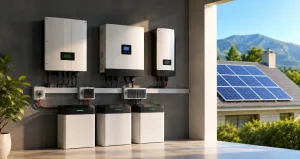
Choosing the best solar battery for a home in South Africa is no longer simply about keeping the lights on during a power interruption. A well-designed battery system can store daytime solar production, reduce dependence on expensive grid electricity and provide reliable backup for essential appliances. The challenge is deciding which battery offers the right combination of usable capacity, discharge power, inverter compatibility, warranty and long-term value.
South African homeowners now have a wide choice of lithium iron phosphate, or LiFePO4, batteries from brands such as Hubble, Sunsynk, Freedom Won and BYD. Prices have also become more competitive, but comparing batteries only by their advertised kilowatt-hour capacity can lead to an expensive mistake. Two batteries with similar capacities may perform very differently when powering a kettle, microwave, borehole pump or several appliances simultaneously.
This guide compares some of the strongest home solar battery options available in South Africa, explains realistic price expectations and examines solar finance and loan options. The aim is to help homeowners choose a system based on actual household requirements rather than simply buying the largest battery they can afford.
Best Solar Batteries for Homes in South Africa
For most households, LiFePO4 batteries are currently the practical starting point. They generally offer long cycle life, good usable capacity and relatively low maintenance. However, brand reputation alone should not determine the purchase. Inverter compatibility, maximum continuous discharge, warranty conditions and local technical support can be equally important.
| Battery | Approx. Capacity | Indicative Battery Price | Best Suited To |
|---|---|---|---|
| Hubble AM-5 | 5.12 kWh | About R19,000–R28,000 | Value-focused home systems |
| Sunsynk W-Series | 5.32 kWh | About R20,000–R30,000 | Sunsynk-based installations |
| Freedom Won eTower | 5 kWh | About R23,000–R30,000 | Expandable premium systems |
| BYD Battery-Box | Varies by configuration | From roughly R30,000 | Modular premium installations |
Important: These are indicative South African battery-only prices rather than guaranteed quotations. Installation, cabling, protection equipment, inverter changes and configuration can substantially increase the final project price.
Hubble AM-5: Strong Value for Typical Homes
The Hubble AM-5 is one of the more interesting choices for homeowners looking for approximately 5 kWh of storage without immediately moving into premium pricing. It has a nominal capacity of 5.12 kWh and uses LiFePO4 prismatic cells. The battery supports CAN communication and multiple units can be connected in parallel for larger storage requirements.
From a practical homeowner perspective, its biggest attraction is balance. A 5.12 kWh battery can be sufficient for essential evening loads such as lighting, internet equipment, televisions, refrigeration and selected electronics when the system is correctly configured. Recent South African retail listings have varied significantly, which is exactly why homeowners should obtain multiple quotations instead of assuming there is one standard national price.
Sunsynk W-Series: Best Match for a Sunsynk Ecosystem
For a household already using a Sunsynk hybrid inverter, a Sunsynk battery is an obvious option to investigate. The W-Series 5.32 kWh model provides roughly the capacity expected from the popular 5 kWh residential battery category. Keeping the inverter and battery within the same ecosystem can also simplify communication, monitoring and installer support.
The advantage here is not necessarily that one brand name automatically provides better storage. It is system integration. In real residential use, correctly configured battery communication and charging limits matter enormously. Homeowners should therefore ask the installer to demonstrate monitoring, charging schedules, minimum state-of-charge settings and backup behaviour before final payment.
Freedom Won eTower: Good for Future Expansion
Freedom Won is a well-established name in the South African energy-storage market. Its eTower platform is particularly appealing when a homeowner wants to begin with approximately 5 kWh and potentially increase storage later. The eTower 5000 provides about 5 kWh per unit and can be expanded by adding compatible modules.
This modular approach makes sense for homeowners whose electricity requirements may increase. For example, adding an air conditioner, home office equipment or other electrical loads later could make additional storage worthwhile. A recent South African listing placed an eTower 5000 at approximately R23,499, although prices and availability should always be confirmed before purchasing.
BYD Battery-Box: Premium Modular Choice
BYD Battery-Box systems deserve consideration when modularity and established battery technology are higher priorities than obtaining the lowest upfront price. Depending on the inverter and system design, homeowners can choose between different Battery-Box configurations and expand storage according to supported specifications.
South African market pricing varies considerably by configuration. Indicative pricing for a Battery-Box LVS 4.0 has been around R30,000 to R38,000, while larger configurations can cost substantially more. BYD therefore tends to make more sense when the complete system design justifies the additional investment rather than when the homeowner simply needs inexpensive basic backup.
How Much Solar Battery Capacity Does a South African Home Need?
This is where many buying decisions go wrong. Battery capacity should be calculated from the appliances you intend to run and how long you need to run them. A larger battery does not automatically solve a poorly designed system.
Consider a household that uses approximately 500 watts continuously on essential loads. Five hours of operation requires around 2.5 kWh before allowing for conversion losses and reserve capacity. A roughly 5 kWh battery may therefore provide comfortable essential-load backup. A home attempting to run multiple high-consumption appliances will require substantially more capacity and, importantly, sufficient discharge power.
Capacity and Power Rating Are Not the Same Thing
One of the most useful lessons when comparing batteries is understanding the difference between kWh and kW. Kilowatt-hours describe how much energy the battery stores. Kilowatts describe how much power the system can deliver at a particular moment.
A battery might contain enough stored energy to run your appliances for several hours but still be unable to support a very large simultaneous load. This is why an installer should evaluate peak consumption as well as daily consumption. Kettles, pumps, ovens, heaters and air conditioners can create high short-term demand that needs to be considered alongside storage capacity.
What Should a Good Home Solar Battery Cost?
A useful way to compare batteries is cost per usable kWh rather than sticker price alone. Suppose Battery A costs R20,000 for approximately 5 kWh while Battery B costs R28,000 for similar storage. Battery A initially looks better, but that conclusion can change if Battery B provides better usable capacity, discharge capability, warranty coverage, expected service life or compatibility with your inverter.
The installed price is also more important than the battery-only price. Ask for a quotation showing the battery, inverter if required, mounting, electrical protection, cables, labour, commissioning and applicable compliance work separately. This makes quotations much easier to compare.
Solar Battery Loan and Finance Options in South Africa
Homeowners who do not want to pay the entire cost upfront can investigate specialised energy finance, home-loan extensions and other structured finance products. Standard Bank, for example, offers an Energy Loan that can finance solar and backup power solutions, with financing of up to R300,000 and repayment periods between 12 and 72 months, subject to approval and applicable terms.
Absa also provides solar and energy finance for qualifying existing home-loan customers through Further Advance or ReAdvance structures. Its published solar finance offering can provide up to R300,000, subject to qualification and the relevant home-loan conditions. Nedbank provides solar asset finance as another option, although eligibility requirements apply.
Before choosing finance, compare the total amount repayable rather than concentrating only on the monthly instalment. Interest, service charges, initiation fees and the repayment period can materially change the true cost of the solar system.
How to Choose the Right Solar Battery?
Start with electricity consumption rather than a particular brand. Review your electricity bills and identify which appliances genuinely need backup. Then determine your evening energy use, peak power requirement and whether future expansion is likely.
Next, confirm inverter compatibility in writing. Compare usable capacity, continuous discharge capability, battery chemistry, warranty conditions and local support. Finally, obtain at least two or three itemised installation quotations. A slightly more expensive battery supported by an experienced installer can be better value than a cheaper product with weak technical support.
Common Solar Battery Buying Mistakes
A common mistake is purchasing purely according to advertised capacity. Another is assuming that every lithium battery communicates correctly with every hybrid inverter. Homeowners should also avoid designing a system around unrealistic expectations, such as powering every high-consumption appliance from a small battery.
Warranty details deserve particular attention. Ask who handles a warranty claim in South Africa, what documentation must be retained and whether the warranty contains operating-condition requirements. The quality of the installer and commissioning process can matter almost as much as the battery itself.
Frequently Asked Questions
1. What is the best solar battery for a home in South Africa?
There is no single battery that is best for every property. Hubble can provide strong value, Sunsynk is attractive for households already using compatible Sunsynk equipment, Freedom Won offers useful expansion options, and BYD is worth considering for premium modular systems. The best choice depends on your inverter, consumption and budget.
2. Is a 5 kWh battery enough for a house?
A 5 kWh-class battery can be sufficient for essential household loads, particularly refrigeration, lighting, Wi-Fi, televisions and electronics. It may not be enough for extended use of high-consumption appliances such as electric heaters, geysers, ovens or multiple air conditioners.
3. How much does a 5 kWh lithium battery cost in South Africa?
Current retail pricing can range from below R20,000 to R30,000 or more depending on brand and supplier. This normally refers to the battery itself. Installation and additional electrical components can raise the total cost.
4. Should I buy one large battery or multiple smaller batteries?
Modular batteries can make future expansion easier because homeowners can start with modest capacity and add compatible modules later. However, expansion rules differ between manufacturers, so confirm supported configurations before purchasing.
5. Are LiFePO4 batteries good for home solar?
LiFePO4 batteries are widely used in modern residential solar systems because they combine useful cycle life, stable chemistry and relatively low maintenance requirements. Their suitability still depends on correct installation, charging parameters and operating temperatures.
6. Can I finance a solar battery in South Africa?
Yes. Several South African financial institutions offer products that can finance solar or backup energy systems. Qualification depends on factors such as income, credit assessment, property circumstances and the finance product selected.
7. Is solar finance better than paying cash?
Cash generally avoids financing costs, but using a large portion of emergency savings may not suit every household. Finance spreads the expense over time but introduces interest and fees. Compare the complete repayment amount with the cash price before deciding.
8. Can I add another battery later?
Many modern systems support expansion, but additional batteries must meet the manufacturer’s requirements. Battery model, age, firmware, communication and inverter limitations may affect expansion, so this should be planned during the original installation.
9. How long should a home solar battery last?
Battery life depends on chemistry, temperature, depth of discharge, charging behaviour and daily cycling. Instead of relying on a simple number of years, examine the manufacturer’s cycle specification and warranty terms and ask how your expected usage affects them.
10. What should I ask a solar installer before buying?
Ask for expected usable battery capacity, maximum continuous power, inverter compatibility, warranty procedure, expansion options and an itemised installed price. You should also request an explanation of how the proposed system was sized from your actual electricity consumption and peak loads.
Conclusion
The best solar battery for a South African home is the one that matches the household’s real energy requirements, inverter and budget. Hubble AM-5 offers compelling value in the popular 5 kWh category, Sunsynk makes particular sense within compatible Sunsynk systems, Freedom Won provides a strong modular option, and BYD deserves consideration for premium expandable installations.
Before buying, calculate essential loads, compare usable capacity and discharge power, verify compatibility and obtain itemised quotations. If financing is required, compare the total repayment cost with the cash price. A correctly sized battery supported by a competent installer will usually deliver more practical value than simply choosing the cheapest or largest battery available.