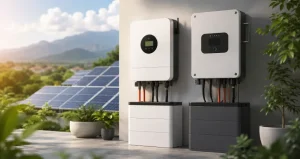
Choosing the best solar inverter in South Africa in 2026 is no longer simply about keeping the lights on during power interruptions. A good inverter now sits at the centre of a household energy system, managing electricity from solar panels, batteries and the grid while helping homeowners reduce the amount of expensive grid electricity they consume.
The market has also matured. South African buyers can choose from established brands such as Sunsynk, Deye and Victron, as well as more affordable alternatives from LuxPower and Growatt. The difficult part is deciding which inverter provides the right balance of reliability, battery compatibility, solar capacity, technical support and price.
This guide compares practical options for different budgets and explains current inverter prices, sizing, installation considerations and financing. Prices should always be treated as estimates because supplier promotions, exchange rates, model revisions and installation requirements can change the final cost.
Best Solar Inverters in South Africa for 2026
For most residential buyers, a 5kW hybrid inverter remains a sensible starting point. Current South African market guides place many mainstream 5kW hybrid units roughly between R14,000 and R30,000, while premium Victron-based configurations can cost considerably more. A hybrid model is particularly useful because it can coordinate solar panels, batteries and grid electricity rather than functioning only as a basic backup inverter.
1. Sunsynk 5kW Hybrid Inverter: Best All-Round Choice
Sunsynk is a strong option for homeowners who want a flexible hybrid system that can be expanded over time. The 5kW category is large enough for essential household circuits and many everyday appliances when loads are managed properly. South African market pricing for a Sunsynk 5kW unit is commonly around R15,000 to R22,000, although packages and newer revisions can differ.
Its main attraction is flexibility. A properly configured system can prioritise solar production, manage battery charging and use grid electricity when required. For a homeowner planning to add more panels or battery storage later, that flexibility can be more valuable than choosing the cheapest inverter available.
2. Deye 5kW Hybrid Inverter: Best Value Hybrid
Deye deserves serious consideration when price-to-performance matters. Current South African listings show the 5kW hybrid at roughly R15,000 to R22,000 across the wider market, with individual 2026 offers appearing around R15,400 to R20,000.
Deye is particularly appealing for buyers who want hybrid functionality without moving into premium-system pricing. It supports the kind of solar, battery and grid integration required by modern residential installations. The important buying consideration is not simply obtaining a low online price, but ensuring that the installer can provide configuration help and warranty support after commissioning.
3. Victron MultiPlus-II: Best Premium and Expandable Option
Victron is aimed at a somewhat different buyer. Rather than competing primarily on initial price, Victron equipment is popular in sophisticated modular installations where system control, expandability and integration matter. South African 5kW-class Victron solutions can fall around R35,000 to R50,000 depending on the equipment included.
The higher upfront cost means it may be excessive for a homeowner wanting only basic backup. However, it becomes much more attractive for technically demanding systems, substantial battery storage, off-grid applications or installations expected to evolve over many years.
4. LuxPower 5kW: Best Budget-Friendly Option
LuxPower offers an interesting route into solar for cost-conscious households. Current South African listings illustrate how inexpensive this category can be, with some 5kW units advertised at approximately R7,000 to R9,000.
The lower equipment price can leave more of the budget available for battery capacity or solar panels. However, buyers should compare the exact model rather than the brand name alone. Grid-interactive capabilities, environmental protection, monitoring, warranty arrangements and battery communication can vary. A cheaper inverter is poor value if the finished installation cannot perform the functions the household actually needs.
5. Growatt 5kW: Best for Buyers Seeking a Mainstream Alternative
Growatt provides another widely available alternative, with South African 5kW pricing commonly estimated at about R14,000 to R20,000. Its competitive pricing makes it worth considering for straightforward residential solar projects.
The deciding factor should be local installer experience and after-sales support. An inverter is not an isolated appliance: its firmware, battery communication, system settings and installation quality all influence the ownership experience. A slightly more expensive system backed by an experienced installer may therefore provide better long-term value.
Solar Inverter Prices in South Africa in 2026
Inverter-only pricing does not represent the cost of a working solar system. Broad 2026 market data puts entry-level 1kVA to 2kVA equipment around R3,000 to R6,000, while a complete 5kVA inverter and approximately 10kWh lithium battery setup can reach roughly R45,000 to R80,000 before considering every possible solar-panel configuration. Installation itself can add approximately R5,000 to R15,000 depending on complexity.
| Inverter | Typical 2026 Price Range | Best Suited To |
|---|---|---|
| Sunsynk 5kW | R15,000–R22,000 | All-round residential systems |
| Deye 5kW | R15,000–R22,000 | Value-focused hybrid systems |
| Victron 5kW class | R35,000–R50,000 | Premium modular systems |
| LuxPower 5kW | From roughly R7,000–R9,000 for selected models | Budget-conscious installations |
| Growatt 5kW | R14,000–R20,000 | Affordable mainstream solar |
These are indicative equipment prices, not quotations. Before purchasing, confirm whether VAT, Wi-Fi modules, CT equipment, breakers, installation, commissioning and warranty support are included.
5kW vs 8kW Inverter: Which Size Should You Buy?
A common mistake is sizing an inverter according to the size of the house instead of simultaneous electrical demand. A 5kW inverter can suit many households running lights, refrigeration, internet equipment, televisions, computers and selected plug circuits. It becomes restrictive when several high-demand appliances operate together.
An 8kW system makes more sense when the household wants greater appliance freedom, has substantial daytime consumption or expects future demand such as additional air conditioning. Before choosing either size, ask the installer for a load assessment showing both normal consumption and peak demand.
Why Battery Compatibility Matters?
The inverter and battery must work as a system. Check supported battery voltage, battery-management-system communication, maximum charging and discharging limits, and the battery manufacturer’s approved inverter list. Installing a powerful inverter with an undersized battery does not automatically provide powerful backup because the battery itself may limit how much energy can safely be delivered.
For this reason, battery capacity should be calculated from the household’s required backup time and expected loads rather than simply matching a popular package advertised online.
Solar Registration and Installation Requirements
Compliance should be considered before equipment is purchased. Eskom requires applicable Small-Scale Embedded Generation systems to be registered, and in March 2026 it extended its registration fee waiver for qualifying systems up to 50kW until 30 September 2026. Requirements can also depend on the local electricity distributor.
Ask the installer whether the proposed inverter is acceptable to the relevant utility or municipality, who will handle registration, and whether the quotation includes the required electrical Certificate of Compliance. Buying hardware first and investigating compliance afterwards can create unnecessary expense.
Solar Inverter Financing Options in South Africa
Households that do not want to pay the entire system cost upfront have several financing routes. The 2026 market includes bank energy loans, home-loan or access-bond funding, instalment arrangements and subscription or rent-to-own models.
Do not compare financing only by the advertised monthly payment. Calculate the total amount payable over the complete term, interest or escalation, installation costs, maintenance responsibilities and any final ownership or buyout amount. Also establish what happens to the agreement if you sell the property early. Financing can make a high-quality system accessible, but the contract matters as much as the equipment.
What I Would Prioritise When Comparing Inverters?
A useful way to evaluate an inverter is to stop asking which brand has the longest feature list and instead ask which complete system will be easiest to live with for the next several years. Prioritise appropriate output capacity, battery compatibility, local warranty support, monitoring, installer competence, compliance and expansion potential.
This matters even more in 2026 because South Africa’s electricity environment has improved. Eskom announced in May 2026 that the country had completed 365 consecutive days without load shedding. Solar therefore increasingly needs to justify itself through energy management, electricity savings, resilience and long-term household needs rather than being purchased solely as emergency backup.
Frequently Asked Questions
1. What is the best solar inverter in South Africa in 2026?
Sunsynk and Deye are strong all-round choices for many residential hybrid installations, while Victron is attractive for premium modular projects. The best choice ultimately depends on budget, battery, required output and local technical support.
2. How much does a 5kW inverter cost?
Mainstream 5kW hybrid inverters commonly cost approximately R14,000 to R30,000, although budget units can cost less and premium configurations considerably more. Installation, batteries and panels are normally additional expenses.
3. Is a 5kW inverter enough for a house?
For many households, yes. It can comfortably support essential circuits and moderate appliance use, but homeowners need to manage simultaneous high-power appliances. Larger consumption profiles may justify an 8kW system.
4. Is Deye or Sunsynk better?
Both are competitive hybrid choices. Rather than choosing solely by logo, compare the exact models, installer expertise, warranty route, battery compatibility and price. Local after-sales support can be more important than small specification differences.
5. Do I need batteries with a hybrid inverter?
Not every configuration requires a battery to use solar generation, but batteries provide stored energy when solar production is insufficient or the grid fails. Confirm the operating modes supported by the exact inverter before designing a battery-free system.
6. How much battery storage should I buy?
Start by calculating how many kilowatt-hours your essential appliances consume during the period you want them supported. A 5kWh battery is a common starting point, but longer backup periods or heavier loads can justify 10kWh or more.
7. Can I finance a solar inverter?
Yes. South African consumers can investigate energy loans, home-loan-linked funding, instalment products and subscription or rent-to-own arrangements. Compare total repayment and ownership terms rather than looking only at the monthly figure.
8. Should I buy an inverter online and find an installer later?
This can save money, but it introduces compatibility and warranty risks. It is safer to have the proposed equipment checked by a competent installer before purchasing, especially when batteries, existing solar panels or municipal registration are involved.
9. Does my solar system need to be registered?
Grid-connected generation can be subject to SSEG registration requirements. The exact process depends on whether Eskom or a municipality supplies the property, so homeowners should confirm the applicable rules before installation.
10. Is solar still worth considering when load shedding has improved?
Potentially, yes, but the reason for buying has changed. A well-designed system can reduce grid consumption, provide resilience against outages and help manage future electricity costs. Its financial value depends heavily on daytime consumption, system price and how effectively the household uses its solar production.
Conclusion
The best solar inverter in South Africa in 2026 is the one that matches the household rather than simply having the biggest capacity or lowest price. Sunsynk and Deye provide compelling hybrid options, Victron suits premium expandable projects, while LuxPower and Growatt can serve more price-sensitive installations.
Before committing, calculate your actual loads, choose compatible battery storage, verify local compliance requirements and compare the total installed price. If financing is required, examine the full repayment cost and ownership conditions. Taking these steps will usually produce a more reliable and financially sensible solar system than choosing an inverter based on brand or price alone.